

What is human trafficking?
What is human trafficking?
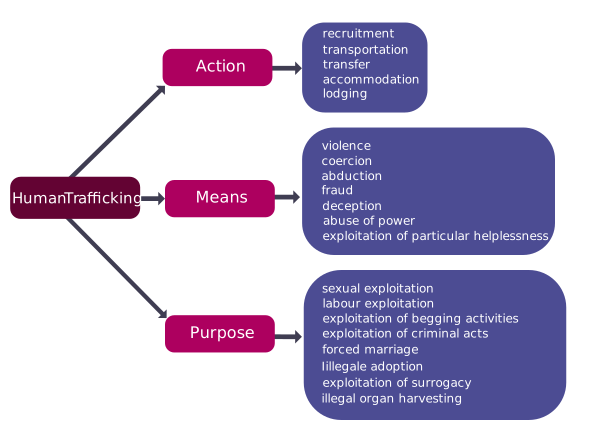
Human trafficking is the practice of exploiting people by placing them in a vulnerable situation. This often involves coercion, duress, deception, or violence. Human trafficking is a human rights violation and can occur within a country or across national borders, in all sectors, and affect a wide variety of people.
Definition
Human trafficking is a serious human rights violation. Human trafficking involves placing individuals in exploitative situations by taking advantage of their vulnerable state, economic hardship, or vulnerability abroad. The latter refers to situations where people find themselves in a country whose language they do not speak or barely speak, whose legal system they are unfamiliar with, and where they lack a social support network. Human trafficking often involves coercion, duress, violence, or deception. The individuals' freedom of action is so severely restricted for the purpose of exploitation that they can no longer freely dispose of their labor or determine their own circumstances.
There are different forms of exploitation:
Human trafficking can occur in all sectors and affect all people. Human trafficking is a form of organized crime.
Criminal law regulations
The German Criminal Code defines what human trafficking means in a legal sense: According to Section 232 of the German Criminal Code (StGB), the recruitment, transportation, receiving and harbouring of a person by exploiting a situation of duress or helplessness with the aim of exploitation constitutes human trafficking and is therefore a criminal offense.
The term "human trafficking" in the German Criminal Code (StGB) is thus relatively narrowly defined and refers only to the creation of conditions that enable exploitation, not the exploitation itself. The individual forms of actual exploitation are criminalized in the following sections of the StGB as forced labour, forced prostitution, exploitation of labour power, and exploitation by taking advantage of deprivation of liberty, as well as in section 180a of the StGB – exploitation of prostitutes.
Currently, the criminal offense of human trafficking (§ 232 of the German Criminal Code) lists five forms of exploitation. With the reform of the EU Trafficking in Human Beings Directive in 2024, the exploitation of surrogacy, forced marriage, and illegal adoption were added as new forms of exploitation. These must be transposed into German law by 2026.
The essential elements of the offense are the intent to exploit and the taking advantage of a situation of duress or helplessness that restricts the affected person's freedom of choice. Additionally, affected persons may be subjected to psychological or physical violence or deception. This can manifest itself in various ways:
- threats or blackmail
- unlawful withholding of documents or earned money
- bodily injuries
- isolation
- list
Young people are given special protection under legislation; therefore, in the case of persons under 21 years of age, there does not need to be a situation of duress or helplessness for the offense of human trafficking to be fulfilled.
Not all situations involving deception and violence constitute human trafficking. In particular, human trafficking should be distinguished from smuggling and prostitution. The KOK (Commission for Crime Prevention) has developed a list of indicators that can help identify human trafficking.
Where does human trafficking take place?
Although human trafficking is often associated with international crime or migration, it does not necessarily involve crossing a border. Human trafficking can also occur within a country.
Human trafficking and exploitation can occur in various contexts. The following sectors are considered particularly vulnerable to human trafficking because they typically do not require a high level of qualification and are labour-intensive:
- sex work/prostitution
- household / care / au pair
- gastronomy and hotel industry
- construction industry
- meat processing industry
- freight forwarding
- nail salons and beauty salons
- agriculture and seasonal work
However, human trafficking can occur in any industry.
Who is affected by human trafficking?
There is no single typical case of human trafficking. The backgrounds and stories of those affected are diverse. Anyone, regardless of age, nationality, or gender, can fall into a situation of exploitation. Minors can be just as vulnerable as adults, and migrants of different nationalities can be just as affected as people with German citizenship.
Certain groups of people are more vulnerable, meaning they are more susceptible to exploitation. This includes, in particular, people with precarious immigration status. Women and transgender people (TIN*) are also often especially vulnerable. In many countries, they have poorer access to education, are affected by structural disadvantages, and simultaneously bear a great deal of responsibility for family members.
More details about the background and causes of human trafficking, as well as statistics on human trafficking, can be found on the KOK website.
Situation of those affected
The situation of those affected is very difficult, and the circumstances they find themselves in further complicate their ability to seek help. They are pressured by perpetrators in a variety of ways, experience violence, or are threatened. They may only be able to move within the immediate vicinity of their workplace or may not be allowed to leave it; they are unfamiliar with the structures in Germany, do not know where to find help, and may not speak the language.
Many victims are severely weakened, physically exhausted, ill, and/or suffering significant psychological distress as a result of the coercive and exploitative relationship. Some are addicted to substances. Because usually at least a large portion of their earnings is withheld, victims often lack the financial means to, for example, find alternative accommodation.
Some victims may not even be aware that they have been the victim of a crime. They may also see themselves as partly responsible, for example, if they have violated immigration laws or worked without a work permit.
For those who have been forced to commit crimes, the fear of being prosecuted themselves is likely to be an even greater obstacle to seeking support.
Should you or someone else require assistance, you can contact a specialist advice centre near you. The KOK's *specialist advice centre search* provides support services and contact details for specialized advice centres for victims of human trafficking throughout Germany, as well as other counselling services.